
Calculating depreciation for insurance claims demands precision and knowledge of industry-standard formulas to ensure fair compensation after property loss. Insurance adjusters evaluate the age, condition, and expected lifespan of damaged items to determine their actual cash value (ACV), a critical factor that directly impacts claim settlements. Understanding depreciation rates and documentation requirements empowers property owners to navigate claims processes effectively and maximize their recovery.
When filing an insurance claim, the difference between replacement cost value (RCV) and actual cash value can amount to thousands of dollars in settlement differences. Professional adjusters apply standardized depreciation schedules to common household items, considering factors such as wear and tear, obsolescence, and market conditions. This systematic approach helps establish transparent and defensible claim valuations while protecting both insurers and policyholders.
This comprehensive guide explores essential depreciation calculation methods, industry-standard life expectancy tables, and proven strategies for documenting item conditions. Whether you’re a homeowner filing a claim or an insurance professional seeking to refine your assessment skills, mastering depreciation principles ensures more accurate and equitable claim settlements.
Several key factors influence how insurance companies calculate furniture depreciation when processing claims. Understanding these elements can help you better prepare your claim and align with standard furniture coverage guidelines.
Age is typically the primary depreciation factor, with most furniture losing 10-30% of its value in the first year alone. Quality and materials play crucial roles too – solid wood pieces generally depreciate more slowly than particleboard furniture, while leather upholstery often maintains value better than synthetic fabrics.
Usage patterns significantly impact depreciation rates. Furniture in high-traffic areas like living rooms and dining rooms typically depreciates faster than pieces in guest rooms or formal spaces. Commercial furniture in busy environments may depreciate even more rapidly due to constant use.
The item’s condition before the damage is equally important. Regular maintenance, minimal wear, and proper care can slow depreciation considerably. Insurance adjusters look for signs of previous repairs, structural integrity, and overall preservation when determining depreciation percentages. Environmental factors like sun exposure, humidity levels, and climate control also influence how quickly furniture loses value.
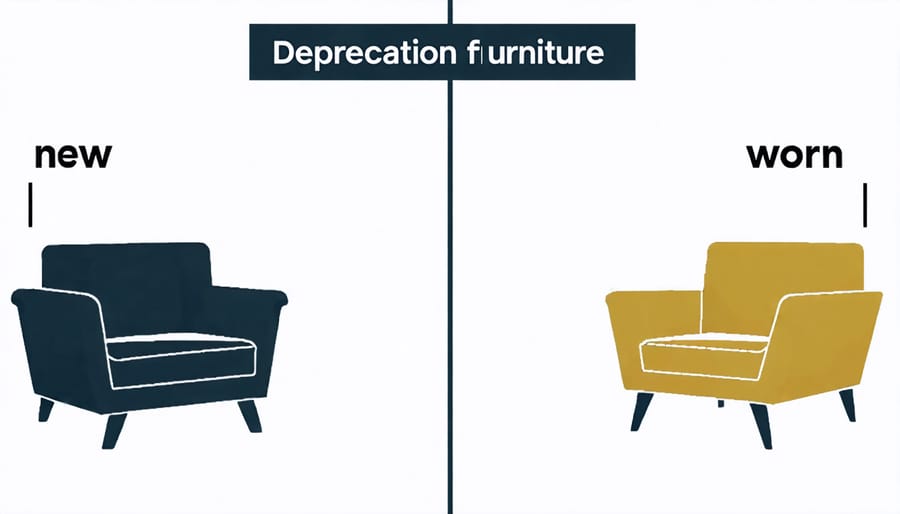
Different furniture types depreciate at varying rates based on their typical lifespan and usage patterns. Upholstered furniture, such as sofas and armchairs, generally depreciates at 12-15% per year due to regular wear and tear. Dining room sets and wooden furniture typically depreciate more slowly, at about 8-10% annually, thanks to their durable construction materials.
Bedroom furniture, including beds and dressers, usually depreciates at 10-12% per year, while office furniture tends to depreciate slightly faster at 12-14% annually due to more frequent use. Outdoor furniture experiences the highest depreciation rate at 15-20% yearly because of exposure to weather elements.
Quality and brand significantly impact these rates. High-end furniture pieces often maintain their value better, depreciating at slower rates of 5-8% annually. Budget furniture typically depreciates faster, sometimes up to 20-25% in the first year alone.
Keep in mind that these rates are general guidelines, and actual depreciation can vary based on maintenance, usage patterns, and local market conditions. Insurance adjusters may consider additional factors such as the furniture’s condition and any existing damage when determining final depreciation values.
To successfully file a depreciation claim, you’ll need to document furniture damage properly with comprehensive supporting materials. Essential documentation includes:
• Original purchase receipts or invoices showing the initial cost and date of purchase
• Clear photographs of the damaged furniture from multiple angles
• Detailed written descriptions of the items’ condition before and after the damage
• Professional appraisals for antique or high-value pieces
• Maintenance records and repair history
• Manufacturer specifications and warranty information
• Recent comparable sales data for similar items
• Video documentation, if available
• Expert assessments from furniture restoration professionals
• Any previous insurance claim history related to the items
For commercial properties, additional documentation may include:
• Asset depreciation schedules
• Business inventory records
• Professional valuation reports
• Equipment maintenance logs
Keep all documentation organized in both digital and physical formats, and make multiple copies for your records. Remember to date all photographs and written descriptions, as this information will be crucial for accurately calculating depreciation values.
When calculating depreciation for insurance claims, several methods can be used, with straight-line depreciation being the most common and straightforward approach. This method assumes that an item loses value evenly over its expected lifespan.
To calculate straight-line depreciation, subtract the estimated salvage value from the original purchase price, then divide by the item’s expected useful life. For example, if you purchased a dining room set for $3,000 with an expected lifespan of 15 years and a salvage value of $300, the annual depreciation would be $180 ($3,000 – $300 ÷ 15).
Insurance adjusters may also use the declining balance method, which assumes items lose more value in their early years. This approach applies a higher depreciation rate initially, which decreases over time. For instance, a leather sofa might depreciate 20% in its first year, 15% in the second, and so on.
Some insurance companies employ condition-based depreciation, where the item’s current condition, rather than age alone, determines its depreciated value. This method considers factors like wear and tear, maintenance history, and market conditions.
Age-life depreciation is another common method that calculates depreciation based on the ratio of an item’s age to its expected lifespan. For a five-year-old armchair with a 20-year life expectancy, the depreciation would be 25% (5 ÷ 20 = 0.25).
Understanding these calculation methods helps ensure fair valuations during claims processing. Keep detailed records of purchase dates, prices, and maintenance to support your depreciation calculations when filing a claim.
Professional appraisal services can significantly influence the outcome of your insurance claim by providing accurate, unbiased valuations of your furniture items. Expert appraisers bring years of experience and specialized knowledge to assess factors that might escape untrained eyes, such as manufacturing quality, materials used, and historical value.
These professionals understand current market conditions and can accurately determine both the original value and depreciated worth of your furniture. They consider subtle details like craftsmanship, brand reputation, and unique features that might affect an item’s value. This expertise often results in more favorable claim settlements compared to standard depreciation calculations.
An expert appraiser can also provide detailed documentation supporting their valuation, which proves invaluable when negotiating with insurance companies. Their reports typically include comprehensive descriptions, photographs, and market comparisons that strengthen your position during the claims process.
For high-value or antique pieces, professional appraisals become particularly crucial. These items often appreciate rather than depreciate, and having an expert’s assessment can prevent significant undervaluation. Many insurance companies actually prefer working with professional appraisals as they provide reliable, third-party verification of item values, potentially streamlining the claims process.
When dealing with depreciation in insurance claims, several common mistakes can lead to claim denials or reduced settlements. One of the most frequent errors is failing to maintain detailed records of furniture purchases, including original receipts and documentation of improvements or repairs. This oversight can make it challenging to establish the item’s original value and age, leading to common claim denial reasons.
Another significant mistake is incorrectly calculating depreciation rates by using arbitrary percentages without considering the item’s actual condition, quality, or market value. Property owners often underestimate the importance of regular photographic documentation, which can prove an item’s condition before damage occurred.
Many claimants also fail to account for proper maintenance and care when assessing depreciation. Well-maintained furniture typically depreciates more slowly than neglected pieces, and documentation of professional cleaning or restoration services can support a lower depreciation rate.
Additionally, overlooking manufacturer warranties or existing insurance riders that might affect depreciation calculations can result in missed opportunities for better claim outcomes. Remember to review all relevant documentation and policies before submitting your claim to ensure accurate depreciation assessment.
Antique and custom furniture pieces require special consideration during the depreciation assessment process due to their unique nature and often significant value. Unlike mass-produced furniture, these items may actually appreciate in value over time, particularly if they’re well-maintained and have historical or artistic significance.
For antique furniture, insurance companies typically require professional appraisals from certified antique specialists to establish accurate values. These appraisals should be updated every 3-5 years to reflect current market conditions. It’s essential to maintain detailed documentation, including photographs, provenance records, and receipts from any restoration work.
Custom-made furniture presents its own challenges in depreciation calculations. The replacement cost often factors in not just materials but also the craftsman’s time, unique design elements, and artistic value. Insurance companies may consider the piece’s replication cost rather than applying standard depreciation formulas.
To protect these valuable items effectively, consider scheduling them separately on your insurance policy. This approach often provides better coverage and may bypass traditional depreciation calculations altogether. Keep detailed records of any professional cleaning, restoration, or preservation treatments, as these can impact both the item’s value and your claim settlement.
Remember to photograph your pieces from multiple angles and maintain an inventory file with all relevant documentation to support your claim if needed.
Commercial and residential insurance claims follow distinct approaches when it comes to furniture depreciation calculations. In residential claims, insurance companies typically consider factors like the age of furniture, its original purchase price, and general wear and tear in everyday household use. For example, a five-year-old living room set might be depreciated differently than office furniture of the same age due to varying usage patterns.
Commercial claims often involve more complex depreciation assessments due to higher-value items and specialized furniture. Business furniture typically experiences more intensive use, leading to accelerated depreciation rates. Insurance adjusters may consider factors such as daily usage hours, number of employees using the furniture, and industry-specific wear patterns. A restaurant’s dining chairs, for instance, might depreciate faster than office chairs in a corporate setting.
Another key difference lies in documentation requirements. Commercial claims usually demand more detailed record-keeping, including maintenance logs, professional cleaning records, and precise purchase documentation. Residential claims, while still requiring proof of ownership and value, generally have more flexible documentation standards.
Both types of claims benefit from professional assessment and documentation of furniture condition, especially when challenging depreciation calculations that seem unfair or inaccurate.
Understanding and documenting depreciation for insurance claims is crucial for achieving fair compensation when furniture is damaged or lost. Throughout this guide, we’ve explored the essential aspects of depreciation calculation, from basic concepts to practical applications in various scenarios.
Remember that successful insurance claims hinge on maintaining detailed records of your furniture, including purchase dates, original costs, and condition photographs. Regular updates to your home inventory, along with proper documentation of maintenance and repairs, can significantly streamline the claims process and help ensure accurate depreciation calculations.
When faced with a claim, always consider factors such as the furniture’s age, quality, brand reputation, and market conditions. While insurance companies use standardized depreciation tables, your detailed documentation can help negotiate more favorable terms, especially for well-maintained, high-quality pieces.
For optimal results, consider working with professional appraisers or furniture restoration experts who can provide expert opinions on your furniture’s condition and value. Their assessments can strengthen your position during claim negotiations and help counter excessive depreciation estimates.
By implementing these practices and maintaining thorough records, you’ll be better prepared to navigate the claims process and receive fair compensation for your furniture. Remember that documentation is your strongest ally in ensuring accurate depreciation calculations and successful insurance claims.