
Your career trajectory isn’t just about climbing a corporate ladder anymore—it’s about choosing which ladder to climb, or whether to build your own entirely. The decision between becoming a franchise partner and pursuing a traditional employee career path represents one of the most significant professional choices you’ll make, each offering distinct rewards, challenges, and lifestyle implications.
Consider your current position: employees trade time for security, receiving steady paychecks, benefits, and clearly defined advancement opportunities within established structures. Franchise partners, conversely, invest capital and effort to own their business destiny, accepting greater risk for potentially unlimited income and autonomy. Neither path is inherently superior—the right choice depends entirely on your financial readiness, risk tolerance, leadership abilities, and personal definition of success.
The franchise model presents a compelling middle ground. You’re not starting from scratch like independent entrepreneurs, nor are you confined to someone else’s vision like traditional employees. Instead, you operate within a proven business framework while building equity in an asset you control. This unique positioning attracts professionals seeking employee-like systems with owner-level rewards.
Understanding these fundamental differences before committing years to either pathway prevents costly career pivots later. Whether you’re an insurance adjuster considering business ownership, a property manager weighing entrepreneurship, or simply someone evaluating long-term career satisfaction, examining both routes through honest comparison reveals which aligns with your values, capabilities, and aspirations. The following analysis provides that clarity without the sales pitch.
A career franchise represents a unique business model that positions itself as much more than a simple investment opportunity. Unlike traditional franchises where owners often remain hands-off and focus purely on return on investment, a career franchise becomes your primary profession and livelihood. Think of it as replacing your job with a business you own and actively operate.
The defining characteristic of a career franchise is your direct, day-to-day involvement in the business operations. You’re not just writing checks and collecting profits from a distance. Instead, you’re developing specialized skills, building client relationships, and growing expertise in your chosen field. This hands-on approach creates multiple income streams: you earn from your own labor while simultaneously building equity in an appreciating business asset.
Consider a furniture repair and restoration franchise as a practical example. Rather than working as an employee for someone else’s furniture company, you own and operate the business yourself. You learn professional restoration techniques, master customer service, and develop a reputation in your local market. Each project you complete builds both immediate income and long-term business value. One franchise partner shared how he transformed from corporate middle management to owning a thriving furniture restoration business: “I went from watching the clock to building something that’s truly mine. Every satisfied customer adds to my reputation and my retirement plan.”
This model emphasizes sustainable wealth building through sweat equity combined with smart business systems. You’re creating a tangible asset that can eventually be sold, passed to family members, or scaled with additional employees. The career franchise pathway offers professional fulfillment alongside financial security, making it fundamentally different from both traditional employment and passive franchise ownership.

Choosing the employee pathway within a franchise system offers tangible benefits that appeal to many professionals seeking stability and growth without the pressures of business ownership. Understanding these advantages helps you make an informed decision about your career direction.
The most immediate benefit is financial predictability. As an employee, you receive a steady paycheck with regular intervals, eliminating the uncertainty that comes with business revenue fluctuations. Your income arrives whether business is booming or experiencing a slower month. Many franchise employees also gain access to benefits packages including health insurance, retirement contributions, and paid time off—perks that franchise owners must fund themselves.
Work-life balance becomes more manageable with predictable schedules. Unlike franchise partners who often work extended hours during the startup phase, employees typically enjoy defined working hours. You clock in, complete your responsibilities, and return home without the constant mental burden of business decisions keeping you awake at night.
Skill development comes with zero financial risk. Franchise systems invest in comprehensive training programs to ensure quality service delivery. Whether you’re learning furniture restoration techniques, customer service protocols, or specialized repair methods, you gain valuable expertise on the company’s dime. One technician shared, “I learned professional upholstery repair and leather restoration without spending a penny on training. That knowledge transformed my career prospects.”
Advancement opportunities exist within established franchise structures. Many franchise organizations promote from within, offering pathways from entry-level technician to team leader, territory manager, or regional supervisor. You can build a rewarding career with increasing responsibility and compensation while someone else handles the business complexities.

While the career franchise path offers meaningful benefits, it’s important to recognize its limitations before committing to this direction. Understanding where the ceiling appears helps you make an informed decision that aligns with your long-term goals.
The most significant constraint involves earning potential. Unlike franchise partners who build equity and enjoy unlimited income growth as their business expands, career franchisees typically face predetermined salary ranges. Even with performance bonuses and advancement opportunities, your compensation remains tied to the employer’s pay structure. Consider Sarah, a restoration technician who excelled in her role for five years. Despite consistently exceeding targets, her raises followed a predetermined schedule that didn’t reflect her exceptional contributions or the revenue she generated.
Control over business decisions presents another ceiling. Career franchisees execute strategies developed by ownership and corporate leadership. You might identify better approaches for your local market or have innovative ideas for service expansion, but implementation requires approval through established channels. This structure works well for those who prefer clear direction, but can feel restrictive for entrepreneurial spirits.
Your success also remains intrinsically tied to your employer’s performance and decisions. If the franchise owner struggles with marketing, manages finances poorly, or fails to invest in equipment upgrades, your career advancement suffers accordingly. You’re building someone else’s dream rather than your own.
Geographic and creative freedom carries limitations too. Transfers between locations aren’t always possible, and you’ll follow established procedures for customer interactions and service delivery. While these systems ensure consistency and quality, they leave little room for personal expression in how you approach your work.
These constraints don’t make the career franchise path wrong, but they do make it distinctly different from ownership. Recognizing these boundaries helps you evaluate whether this pathway genuinely matches your professional aspirations and personal priorities.
One of the most compelling advantages of becoming a franchise partner is the ability to step into business ownership without the trial-and-error phase that typically comes with starting from the ground up. When you choose the franchise path, you’re acquiring a complete business blueprint that has already proven successful in the marketplace.
From day one, you benefit from an established brand that customers already recognize and trust. This immediate credibility can take independent businesses years to build. You’re not spending valuable time and resources convincing the market that your services are legitimate—that foundation is already in place.
The comprehensive training programs offered to franchise partners eliminate the steep learning curve of figuring everything out independently. You receive hands-on instruction in technical skills, business operations, customer service protocols, and marketing strategies. This isn’t a sink-or-swim scenario; you’re equipped with knowledge that took the franchisor years to refine.
Beyond initial training, ongoing support becomes your safety net and growth accelerator. Questions about handling a unique customer situation? Guidance is just a phone call away. Need help with a marketing campaign? Templates and strategies are ready to implement. This continuous partnership means you’re never truly alone in your business decisions.
Consider Sarah, a franchise partner who transitioned from property management. “I had the drive to own a business but zero experience running one,” she shares. “The franchise system gave me everything I needed—from scheduling software to pricing guidelines. Within six months, I was profitable and confident.”
You maintain complete ownership and control over your territory and daily operations, but you’re backed by a proven system that dramatically reduces risk and accelerates your path to profitability.
One of the most compelling advantages of the franchise partner pathway is the direct correlation between your effort and your income. Unlike traditional employment with predetermined salary caps and modest annual raises, franchise ownership offers truly unlimited earning potential. Your financial success depends on your business acumen, work ethic, and strategic decisions rather than corporate budget constraints or arbitrary pay grades.
In the furniture repair and restoration industry, franchise partners have the unique ability to scale their operations according to their ambitions. You might start as a single-operator business, personally handling service calls and building your customer base. As demand grows, you can hire trained technicians, expanding your capacity to serve more clients simultaneously. This growth trajectory allows you to transition from working in your business to working on your business, focusing on strategic expansion while your team handles day-to-day operations.
Multiple revenue streams further enhance your earning potential. Beyond basic furniture repair, successful franchise partners develop income from restoration services, insurance claim work, commercial contracts with property management companies, and specialized services like leather conditioning or antique furniture restoration. Each stream represents an opportunity to diversify and stabilize your income.
Perhaps most significantly, every dollar you invest in marketing, every customer relationship you nurture, and every system you refine builds equity in a tangible business asset. Unlike a traditional career where you leave with only your 401k, franchise partners create sellable businesses. When you’re ready to retire or pursue new ventures, your franchise represents a valuable asset with real market value.
Take James, a former corporate manager who purchased a furniture restoration franchise five years ago. He doubled his employed salary in year two, now employs four technicians, and recently received a preliminary business valuation significantly exceeding his initial investment. His success demonstrates what determined effort can achieve through franchise ownership.

The financial landscapes of these two career paths differ dramatically. As an employee, your initial investment is minimal—perhaps professional attire and transportation costs. Your income arrives predictably through regular paychecks, offering immediate financial security and benefits like health insurance and retirement contributions. However, your earning potential typically caps at your salary ceiling, with raises averaging 3-5% annually in most industries.
Franchise partnership requires substantial upfront capital. For furniture repair franchises, initial investments often range from $50,000 to $150,000, covering franchise fees, equipment, inventory, and working capital. This represents significant financial risk, especially during the critical first year when you’re building your customer base. Many franchise partners report operating at break-even or modest profit initially.
The long-term financial picture shifts considerably. Successful franchise partners frequently exceed employee earnings within 3-5 years, with income potential growing exponentially as their business matures. You’re building equity in a tangible asset that can be sold or passed to family members. One furniture restoration franchise partner shared: “My fifth year revenue tripled my former corporate salary, and I’m creating generational wealth.” The trade-off is clear: short-term financial uncertainty for potentially unlimited long-term gains versus steady, predictable income with defined limitations.
As an employee, your schedule and business decisions are predetermined by management. You follow established protocols, work set hours, and execute strategies created by others. While this structure provides stability, it limits your ability to shape how work gets done.
Franchise partners gain significantly more autonomy. You control your daily schedule, decide when to take time off, and determine how to grow your business within the franchise framework. Want to target commercial property managers more aggressively in your territory? That’s your call. Need to adjust your hours to attend a child’s school event? You have that flexibility.
However, this freedom comes with responsibility. Franchise partners must balance independence with franchise system requirements, brand standards, and proven operational methods. You’re not entirely on your own—the franchise provides guidelines and support—but you’re the decision-maker for your local operation. This middle ground appeals to entrepreneurs who want ownership benefits without starting completely from scratch.
Career progression differs significantly between franchise ownership and employment. Franchise partners typically experience uncapped earning potential, with income directly tied to business performance and expansion. Many successful franchise owners scale their operations by opening multiple locations, building substantial equity and creating transferable assets for retirement or family legacy.
Employees follow more structured advancement, progressing through service technician roles to senior craftsman, regional manager, or training specialist positions. While income growth is steadier and more predictable, it generally has defined ceilings based on position and experience level.
Skill development varies too. Franchise partners develop comprehensive business acumen including marketing, financial management, customer relations, and team leadership alongside technical restoration expertise. Employees deepen specialized technical skills and may gain supervisory experience, but typically focus within narrower operational scopes.
For legacy building, franchise ownership offers equity accumulation and succession planning opportunities. One franchise partner shared: “I’m not just building a paycheck—I’m creating something my children can inherit.” Employees build valuable career credentials and industry expertise, though without ownership stakes in company growth.
Not everyone flourishes as a franchise partner, and that’s perfectly fine. Understanding whether this path aligns with your natural strengths and circumstances can save you time, money, and unnecessary stress.
Successful franchise partners typically share several key characteristics. Self-motivation ranks at the top. Unlike traditional employment where supervisors provide daily direction, franchise ownership requires you to set your own schedule, hold yourself accountable, and push through challenges without someone looking over your shoulder. One furniture restoration franchise partner we spoke with mentioned that the hardest adjustment was realizing “nobody cares about my success more than I do.”
Financial readiness extends beyond having the initial investment available. You’ll need reserves to cover personal expenses during the ramp-up period, typically six to twelve months before consistent income materializes. The willingness to invest both money and time distinguishes serious candidates from dreamers.
Customer service orientation matters tremendously, especially in service-based franchises. You’re not just managing operations; you’re building relationships that generate referrals and repeat business. If you genuinely enjoy solving problems for others and can remain patient during difficult conversations, you’ll have a significant advantage.
Basic business acumen helps, though franchise systems provide extensive training. Understanding simple financial statements, managing cash flow, and making data-driven decisions are learnable skills that successful partners develop over time.
Real-world indicators suggest you might thrive as a franchise partner if you’ve previously managed projects from start to finish, coordinated teams (even informally), or felt frustrated by limited growth opportunities in traditional employment. Perhaps you’ve already been researching business opportunities for months, demonstrating the persistence this journey requires.
The franchise partnership path rewards those who balance following proven systems with taking ownership of their results.
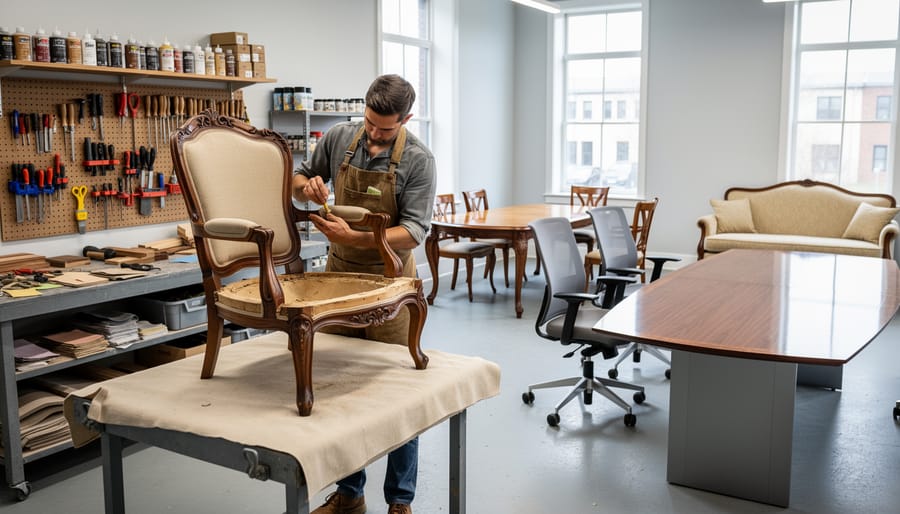
When economic uncertainty strikes, furniture repair and restoration franchises often experience increased demand rather than decline. During recessions, both homeowners and businesses tighten budgets, making repair and restoration a financially sensible alternative to expensive furniture replacement. A sofa restoration, for example, typically costs 40-60% less than purchasing new, making it an attractive option when household income becomes stretched.
This recession-resistant model extends beyond consumer frugality. Insurance claim work creates consistent revenue streams regardless of economic conditions. Water damage, fire restoration, and accident-related furniture repairs continue year-round, with insurance companies covering costs. Many franchise partners report that insurance restoration work comprises 30-50% of their annual revenue, providing stability during market downturns.
Commercial property managers also prioritize restoration during economic slowdowns. Hotels, offices, and healthcare facilities need to maintain professional appearances while controlling capital expenditures. Repairing lobby furniture or restoring executive office pieces becomes the prudent choice over budget-draining replacements.
This counter-cyclical demand pattern makes furniture restoration franchises particularly appealing for aspiring business owners seeking income stability. Unlike retail-dependent businesses that suffer during recessions, restoration services often thrive, demonstrating why this career pathway offers financial resilience that traditional employment frequently cannot match.
One of the most compelling advantages of franchise ownership is the ability to generate income from multiple sources simultaneously. Unlike traditional employment with a single salary, a furniture repair and restoration franchise opens doors to various revenue channels that can grow over time.
Residential customers provide steady income through furniture repairs, leather restoration, and wood refinishing projects. Meanwhile, commercial contracts with hotels, restaurants, and office buildings create predictable monthly revenue streams. These businesses need ongoing maintenance for their lobby furniture, restaurant seating, and executive office pieces.
Insurance partnerships represent another profitable avenue. When furniture is damaged in fires, floods, or accidents, insurance companies often prefer restoration over replacement. By building relationships with insurance adjusters, franchise owners can secure consistent referral business for restoration projects.
Property management companies and real estate professionals also become valuable partners. They regularly need furniture touch-ups for model homes, apartment turnovers, and property staging situations. Some franchise owners report that a single property management relationship can generate thousands in monthly revenue.
The beauty of this model is diversification. When one revenue stream slows seasonally, others typically remain strong, creating year-round business stability that traditional employment rarely offers.
The choice between pursuing a career franchise or continuing on a traditional employee pathway isn’t about right or wrong—it’s about what aligns with your personal vision of success. Both paths offer genuine opportunities for growth, fulfillment, and financial stability. The key difference lies in how you want to achieve those outcomes.
As an employee, you benefit from established structures, predictable income, and the ability to focus on developing expertise without bearing business risks. As a franchise partner, you gain autonomy, unlimited earning potential, and the satisfaction of building something that’s truly yours—with the support of a proven system behind you.
Neither choice is universally superior. Your ideal path depends on your risk tolerance, lifestyle preferences, financial goals, and how you define success. Some professionals thrive under the security and mentorship that traditional employment provides. Others find their calling in the challenges and rewards of ownership, discovering capabilities they never knew they had.
Take time for honest self-reflection. What energizes you? Where do you see yourself in five or ten years? What kind of legacy do you want to build? Your answers will guide you toward the pathway that fits.
If the idea of ownership resonates with you, exploring franchise opportunities in industries like furniture restoration can be an enlightening next step. The franchise model offers a middle ground—entrepreneurship with guidance—that might be exactly what you’re looking for in your next career chapter.