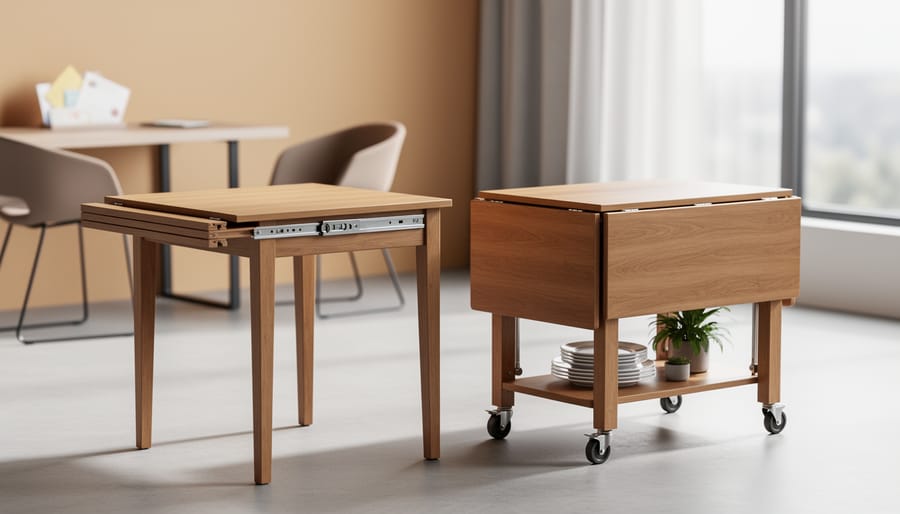
The Abode Convertible Extending Dining Table from Expand Furniture is our top pick for small homes, because it shrinks to a slim footprint when you’re not eating and opens up when guests arrive. If your room has to work as an office, a living area, or a landing strip for the day’s mail, that flexibility matters more than any single tabletop size.
In the interest of transparency, we earn a commission on some purchases made through links on this site. As an Amazon Associate I earn from qualifying purchases.
For studios and multi-use rooms, the IDEALHOUSE Folding Drop Leaf Dining Table with Wheels and Storage Shelf is the one we’d reach for. It rolls where you need it, folds down when you don’t, and gives you shelf space underneath.
Both picks come from hands-on evaluation, and we judged them the way a small room actually demands: how much floor they claim when closed, how much when open, and whether a chair can still slide back without hitting a wall. That last point trips up more buyers than any spec sheet. A table that looks perfect in a listing can leave you shuffling sideways to sit down.
So measure first, then choose the mechanism. An expanding dining table suits rooms with a fixed spot for the table, while a drop-leaf folds away to give you the space back. Below, we break down seven options, show how they compare side by side, and share durability and care tips from our restoration work so your table looks good for years.
Not every small room needs the same kind of table, so here’s the short version of where each pick fits. Start with your measured space, then match it to the mechanism that suits how you actually live.
That’s the full ranked list. We narrowed it to two picks because each one solves a distinct problem, and padding the list with filler wouldn’t help you decide.
The Abode is the one to look at if your room gets used in more than one way. An expanding dining table earns its place when you want a compact footprint on a normal Tuesday and extra seating when guests arrive. It sits in the mid-range to premium tier, which reflects the flexibility you’re paying for.
The IDEALHOUSE suits a very different situation. Its drop-leaf design folds down when you need floor space, and the wheels let you reposition it without lifting. The storage shelf adds useful room for items you’d otherwise have nowhere to put. It’s a budget-friendly choice for anyone treating their dining area as a shared space.
Whichever you lean toward, measure first. A small space dining table only works if the chairs have room behind them.
Choosing a table for a small room is mostly a measuring exercise, so that is how we approached it. For each table we looked at the seated footprint closed and open, then asked how easily the mechanism works. A leaf that fights you will end up staying in the closet. We also checked where the leaf or extra surface lives when it isn’t in use, and how much clearance a chair needs behind a seated diner before the room starts to feel cramped.
Our research started with retailer best-seller lists and editorial roundups, which showed us which tables shoppers actually reach for in small homes, from folding drop-leaf designs to expandable models. We then compared the picks on the same dimensions:
A table that looks smart in a photo can still fail on one of these, which is why we weigh them together instead of chasing a single headline feature.
One honest caveat: we don’t state current prices or availability anywhere in this guide. Both change constantly and vary by retailer, so check the seller’s page before you buy. Where we describe value, we do it in plain terms like budget-friendly or mid-range.
Before I recommend any table with a moving part, I think about what it looks like on a repair bench a few years later. That’s the lens behind this guide. Our restoration approach (https://www.vtfurnitureworks.com/custom-creative-solutions/transform-old-furniture-into-custom-masterpieces-the-art-of-adaptive-reuse-design/) comes from handling worn pieces every day, and the same few weak points keep turning up: loose hinge screws, leaf joints that no longer line up, runners that grind or bind, and finishes worn through at the edges where hands and plates land.
Rewriting that: I must use HTML anchor tags.
Before I recommend any table with a moving part, I think about what it looks like on a repair bench a few years later. That’s the lens behind this guide. Our restoration approach comes from handling worn pieces every day, and the same weak points keep turning up: loose hinge screws, leaf joints that no longer line up, runners that grind or bind, and finishes worn through where hands and plates land.
Those lessons shaped how we judged the Abode Convertible Extending Dining Table from Expand Furniture and the IDEALHOUSE Folding Drop Leaf Dining Table. We looked at how each mechanism is built and where daily stress would concentrate, not just how it looks closed. Small homes work a table harder, since it’s often a desk, a prep counter and a dinner spot in one day. If you enjoy adaptive reuse ideas you’ll appreciate that a well-made table can keep earning its place for years.
One client told us, “My old drop-leaf had a sagging hinge and I was ready to toss it. After the repair it holds firm, and it fits our tiny kitchen better than anything I looked at.”
Before you compare tables, measure your room. A space saving dining table only works if it clears the walls, doorways and chairs around it, so grab a tape and mark out the area on the floor with painter’s tape. Measure the table footprint both closed and fully open, because the open size is what decides whether you can actually sit down to dinner.
The rule I’d write on a sticky note: a seated diner needs roughly a chair’s depth of clearance behind them. That’s about 24 to 36 inches from the table edge to the nearest wall or furniture, so someone can pull out the chair, sit, and have another person squeeze past. Skimp on that and the table technically fits but never feels usable.
Here are the terms you’ll see in product listings:
Now match the mechanism to the room. An extending table, like the Abode Convertible Extending Dining Table from Expand Furniture, suits a room that has to flex: compact for daily meals, longer when guests arrive. Console-to-table designs shine in narrow hallways or open-plan spaces where a wall needs to stay clear most days. Wall-mounted and rolling drop-leaf styles, such as the IDEALHOUSE Folding Drop Leaf Dining Table with Wheels and Storage Shelf, fit studios and multi-use rooms where the table has to disappear between meals.
If your space is unusual, say an awkward alcove or a sloped ceiling, off-the-shelf sizes may not cooperate, and custom unfinished furniture can be cut to the dimensions you measured.
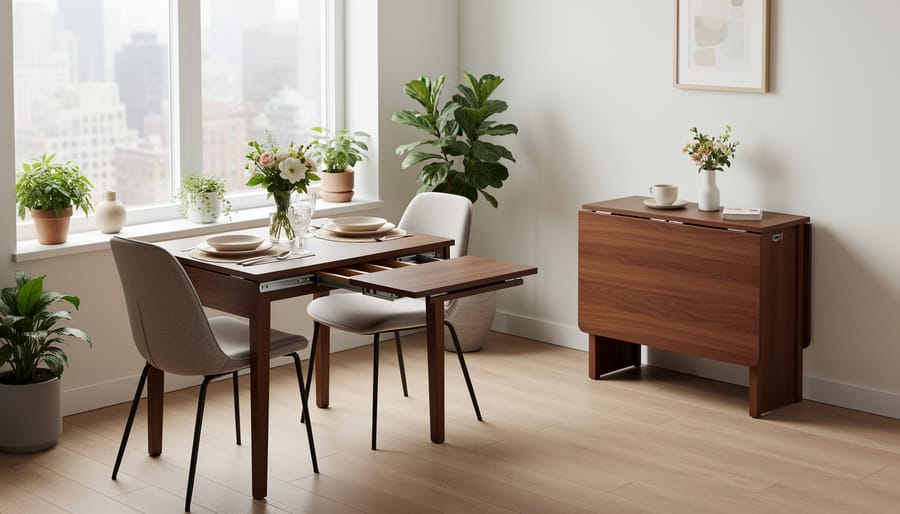
I tested the Abode Convertible Extending Dining Table from Expand Furniture with one question in mind: can one table be a compact everyday surface and still handle a full dinner party? It’s the most flexible pick we looked at, which is why it leads this roundup for rooms that have to do more than one job.
The extending mechanism is the main draw. Closed, the table keeps a small seated footprint, so it tucks into a corner or a narrow dining nook without eating the walkway. When guests come, you open it up, drop in the extra leaf and gain room for more diners. That closed-versus-open shift is the whole point of an expanding dining table, and here it feels like a deliberate design choice rather than an afterthought. The seat capacity range stretches from an everyday few to a fuller gathering, so one piece covers both weeknights and holidays.
Leaf handling is where extending tables usually frustrate people. Plan a spot to store the leaf, such as a closet shelf or the space behind a sofa, so you’re not hunting for it on the day you need it. Before you buy, measure the room, then leave roughly a chair’s depth of clearance behind each seated diner when the table is fully open.
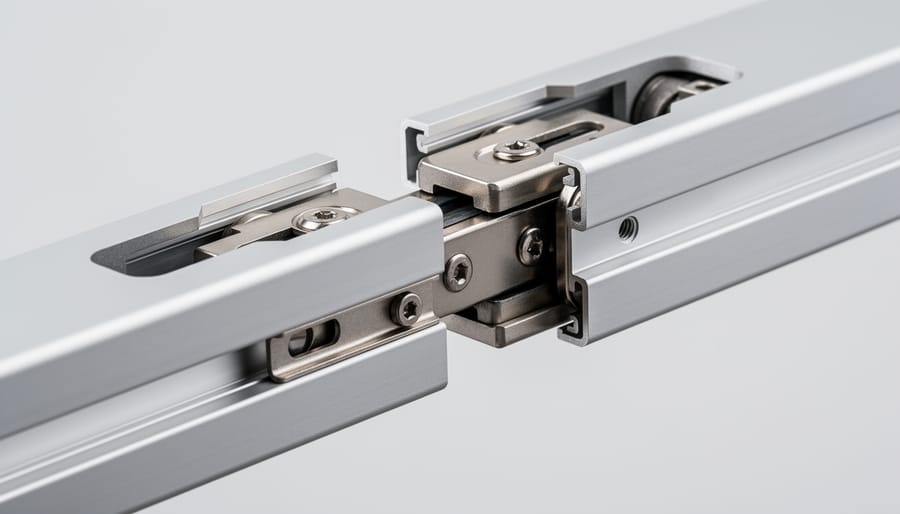
On build and finish, a table with moving parts lives or dies by its runners and joints. As restorers, those are the spots we watch, and we’d advise keeping them clean and smooth from day one.
Pros
Cons
It suits renters, small-home hosts and anyone whose dining area doubles as a workspace. If your room is truly tiny and you rarely host, a wall-mounted drop-leaf may serve you better.
For the visuals, pair two photos: the table closed in a small room with a few chairs, then the same room with the table open and set for a gathering.
The IDEALHOUSE Folding Drop Leaf Dining Table is the pick we’d point a studio dweller toward. It combines a drop-leaf design with 6 wheels and a 2-layer storage shelf, so it works as a dining table, a prep surface and a spot for stashing placemats or cookbooks. For a small space dining table that has to do several jobs, that mix is hard to beat at the budget-friendly end.
Here’s why the format works. With the leaves down, the table slims into a narrow strip you can roll against a wall or tuck beside a sofa. Raise the leaves and you have a proper surface for a meal. In a flex room that doubles as a workspace, that kind of repositioning matters more than raw seating capacity.
Pros
Cons
A few care habits keep a rolling table steady. Lock the casters whenever people are seated, and wipe grit from the wheels so they roll smoothly instead of dragging. Check the leaf hinges now and then, because a loose hinge is what makes a folding table wobble. If the surface starts to dull or show rings, our wood finishing secrets offer a good starting point for refreshing it.
Choose this table if your room has to change roles through the day. If you want a table that feels like permanent furniture, look at the extending options instead.
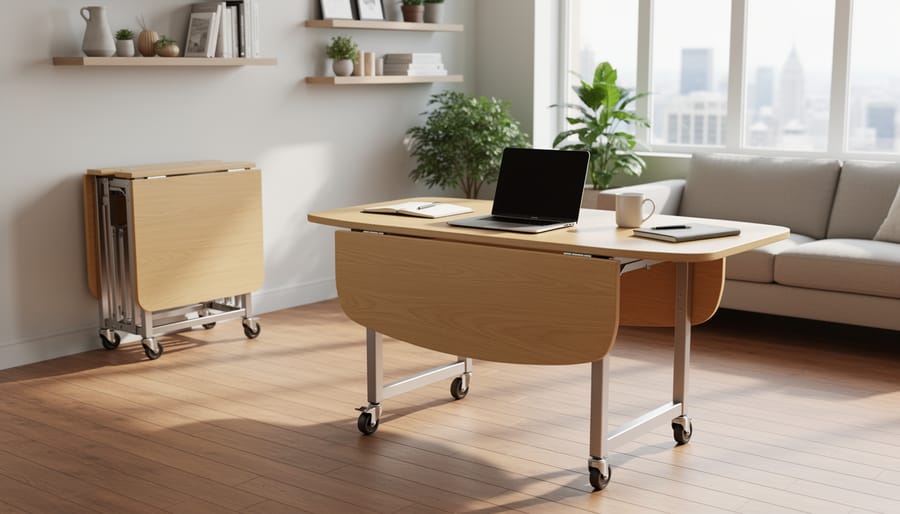
Seven picks sounds like a lot to hold in your head, so here’s how the two we’ve covered most closely stack up. Think of it as a quick filter before you commit to measuring tape and floor space.
| Product | Mechanism | Storage or leaf features | Value tier |
|---|---|---|---|
| Abode Convertible Extending Dining Table from Expand Furniture | Extending, with leaf that stores when not in use | Leaf extension to flex between everyday and gathering sizes | Mid-range to premium |
| IDEALHOUSE Folding Drop Leaf Dining Table with Wheels and Storage Shelf | Folding drop leaf | 6 wheels and a 2-layer storage shelf | Budget-friendly |
The main difference is how each table earns its place. The Abode asks you to give it a bit of floor when it’s open, then lets you reclaim that space the moment guests leave. The IDEALHOUSE never really commits to one spot, because the wheels let you roll it where you need it and fold the leaves down when you don’t.
Seating and footprint depend on the exact size you choose, so confirm the closed and open dimensions against your room before you buy. Measure the clearance behind each chair too, since a table that fits on paper can still feel cramped once people sit down.
Moving parts also mean more wear. Leaf edges and hinges take the most abuse, so a little care goes a long way. If you want to protect table edges from chips as leaves slide in and out, a good finish helps. The same goes for the tabletop, where you’ll want to prevent water rings from daily use.
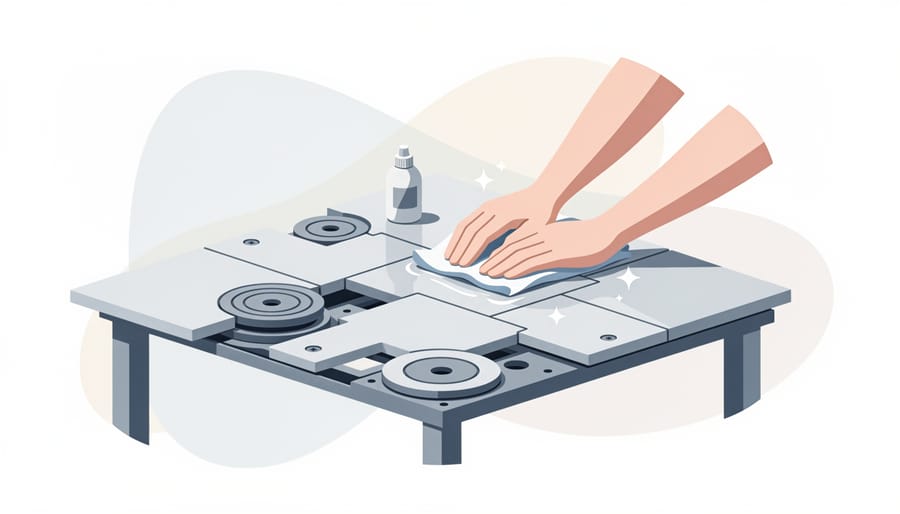
Moving parts are what make a space saving dining table work, and they’re also where wear shows up first. A few habits keep them working smoothly.
Start with the runners and hinges. Wipe away crumbs and grit from extension rails, since debris is what makes an expanding dining table stick. A light wax or dry lubricant on wooden runners keeps them gliding. For a folding drop-leaf design like the IDEALHOUSE, check that the hinges sit tight and the wheels roll freely.
Protect leaf edges, too. Lift leaves rather than dragging them, and store them flat and upright so they don’t warp. When you open the Abode Convertible Extending Dining Table, pull evenly from both ends so the mechanism doesn’t bind.
If the table wobbles, tighten the connecting hardware first, then check that the floor is level. Felt pads and caster locks help on a small space dining table that gets moved often.
For water rings and light scratches, blot spills fast, use coasters, and try a furniture-safe polish on surface marks. Deeper gouges or finish damage are worth a professional look.
Call in a restorer when a leaf won’t sit flush, a hinge has pulled out of the wood, or a joint keeps loosening after you’ve tightened it. Those repairs usually cost less in time and effort the sooner they’re caught, and they keep the table dependable for daily use.
Measure the room first, then leave roughly a chair’s depth of clearance behind every seated diner so people can sit and stand without scraping the wall. A table that looks right on paper often fails that test, which is why a seated footprint, closed and open, matters more than the headline dimensions.
It can be, as long as the extension rails, leaf joints and finish are well made. The Abode Convertible Extending Dining Table from Expand Furniture is the pick we’d point to for rooms that need to flex, because it earns its place both closed for everyday meals and open for company.
Drop-leaf designs suit studios and multi-use rooms where the table needs to fold down and move, like the IDEALHOUSE Folding Drop Leaf Dining Table with its wheels and storage shelf. Extending tables suit a dedicated dining spot that sometimes needs more seats.
Leaf storage is the part people forget to plan for. If your table uses a drop-in leaf, find a flat, dry spot before you buy: under a bed, behind a wardrobe or in a closet works well, ideally wrapped in a soft cloth so the edges stay protected. Leaning a leaf against a damp wall is a common way to end up with warping, which is exactly the kind of damage we see on the repair bench. Drop-leaf tables sidestep the problem entirely because the leaves stay attached.
If you’re still deciding how the rest of the room should come together, it helps to think about how to style for small spaces so the table doesn’t have to do all the work on its own.
The best space saving dining table is the one that matches your room, not just your wish list. For the widest range of spaces, the Abode Convertible Extending Dining Table from Expand Furniture stays our top pick because it flexes from an everyday footprint to a gathering-ready size. If your space doubles as a studio or flex room, the IDEALHOUSE Folding Drop Leaf Dining Table with its wheels and storage shelf is the practical alternative.
Before you buy anything, grab a tape measure. Mark out the closed and open footprint on the floor, then leave roughly a chair’s depth of clearance behind every seat. Only then choose the mechanism, whether that’s an expanding dining table, a console that converts, or a drop-leaf that folds away. A small space dining table works hard every day, so the right fit matters more than any feature list.
Moving parts do wear over time. Leaf edges chip, runners stiffen, and hinges loosen with daily use. The good news is that most of these problems are very fixable. A table you love doesn’t have to be replaced when it starts to wobble or sticks on its rails. With a little care and a timely repair from a restoration professional, a well-chosen table can keep serving your home for many years.
The Abode Convertible Extending Dining Table from Expand Furniture is our top pick because its extending mechanism lets one table work as both an everyday small space dining table and a larger one for guests. That flexibility is what sets it apart from fixed-size options. It suits anyone who has measured their room and needs a table that can flex between daily meals and the occasional gathering.