
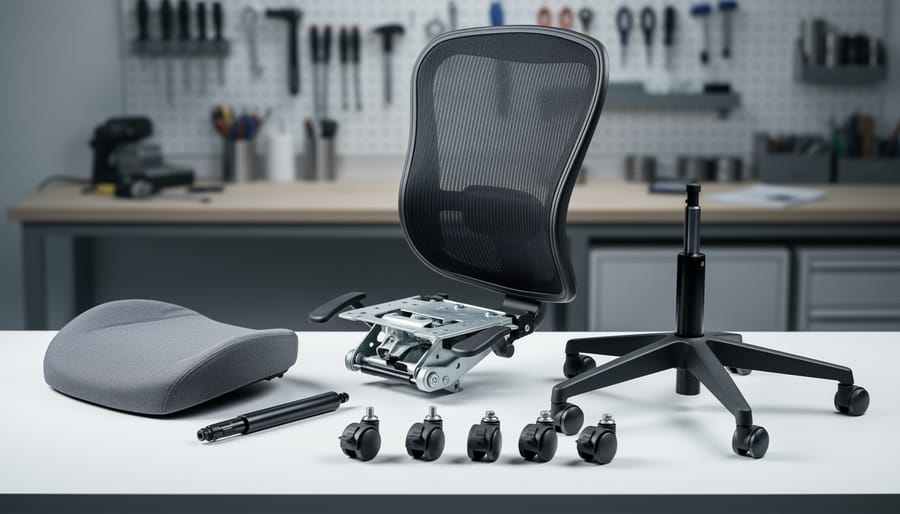
An office chair parts diagram is a labeled illustration that shows every component of a task chair and where it sits, from the seat and backrest down through the tilt mechanism, gas cylinder, base, and casters. Think of it as a map for your chair. Once you can read it, you can name the part that’s failing, order the right replacement, and explain the problem to a repairer in a single sentence.
That matters more than you’d expect. A chair that sinks, wobbles, or won’t recline is rarely beyond saving, but ordering the wrong cylinder or the wrong caster stem wastes time and money. Most fixes come down to one worn part, and many of the same office furniture connectors and fittings show up across brands.
This guide walks through the chair zone by zone, starting with the seat and back, then the mechanism, then the base. A quick-reference table makes scanning easy, and you’ll see how the parts work together so the next repair feels like a clear, manageable job.
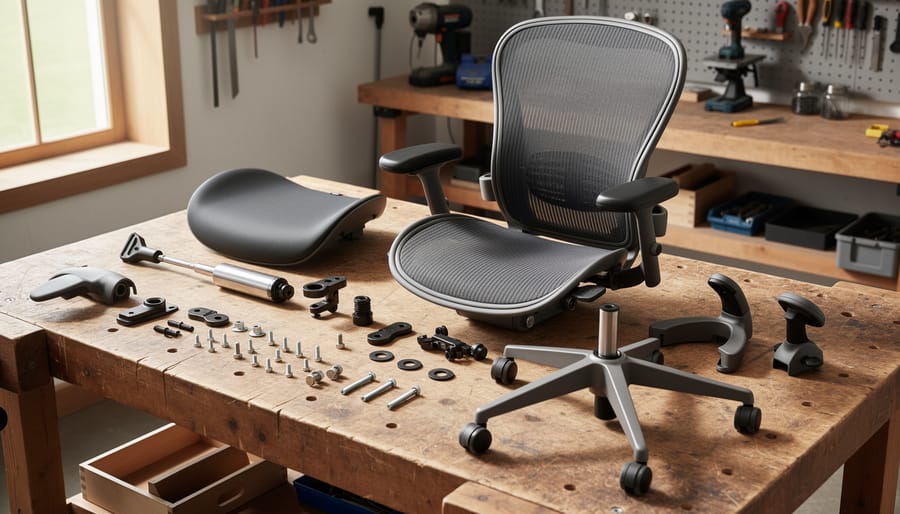
An office chair parts diagram is a labeled illustration that names each component of a chair and shows how the pieces connect. Think of it as a map: once you can read it, you can point to exactly where a problem lives instead of saying “something under the seat is off.”
You’ll usually run into two views. An exploded view pulls the chair apart on the page, with each part floating in line above or below the one it attaches to. It’s the better choice when you want to see every piece, including small hardware like washers and clips. An assembled view shows the chair as it looks when put together, with labels pointing to the parts you can actually see from the outside. It’s handy for orienting yourself quickly.
Most diagrams group parts into three zones. The seat zone covers the cushion, the backrest, and the armrests. The lift-and-tilt system sits underneath, holding the adjustment lever, the tilt mechanism, and the gas cylinder that raises and lowers you. The base zone includes the star-shaped legs and the casters, or wheels, that carry the whole chair.
To read a diagram, start at the top and work down, the same way the chair is built. Find a feature you recognize, like the height lever or the wheels, and match the label to it. Then follow the connecting lines to the neighboring parts. If your chair looks slightly different from the drawing, that’s normal. Brands vary in shape, but the zones and the order of parts stay the same.
Keep these three zones in mind as we move through each part by name.
The top half of an office chair is where most of the comfort happens, and it’s built from a handful of parts that stack and bolt together in a predictable order. At the center is the seat pan, a rigid plate (usually molded plastic or plywood) sitting directly on the mechanism below. The seat cushion and foam rest on top of it, and the upholstery or mesh stretches over the surface you actually touch.
Behind you, the backrest attaches to a back frame that rises from the seat or mechanism, and the lumbar support nestles into the curve of your lower spine. Some chairs add a headrest above the backrest, while armrests mount low on the sides, each one pairing an arm post (the vertical support) with a padded top.
Here’s a quick glossary of the terms you’ll see most often on a diagram:
Knowing which part is which makes problems easier to pinpoint. A flattened seat usually means worn foam, a torn surface points to the upholstery, and a loose arm often traces back to the arm post or its mounting screws rather than the pad itself.
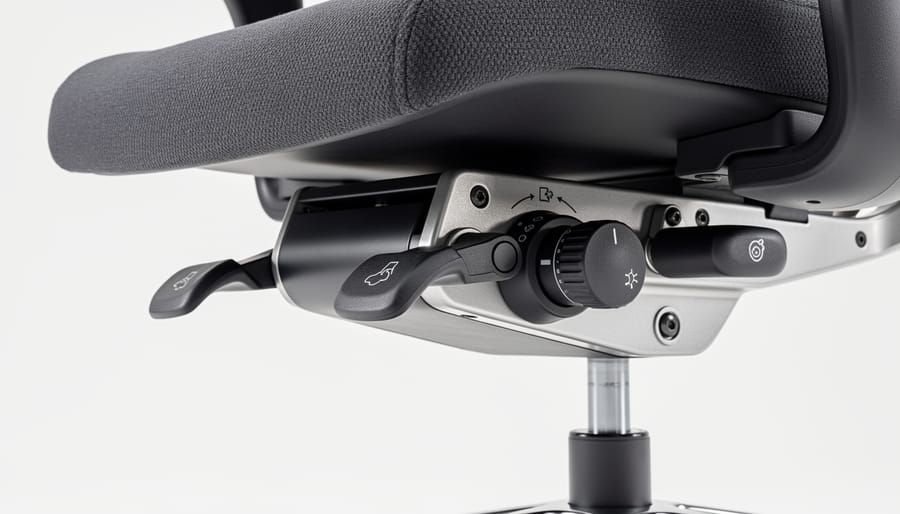
Directly beneath the seat pan sits the tilt mechanism, often called the control plate or control box. It’s the metal housing that connects the seat to the backrest and to the chair’s height column. Most of the controls you touch every day are attached to it.
The height adjustment lever is usually a small paddle on one side of the mechanism. When you pull or press it, you’re opening a valve inside the gas lift cylinder, the sealed pneumatic column rising from the center of the base. That cylinder holds compressed gas. With the valve open and your weight off the seat, the gas pushes the seat upward. Sit down while holding the lever and your weight compresses the gas, lowering the seat. Let go, and the valve closes and locks the height in place.
The tilt mechanism handles recline. Inside the housing, a spring (or a set of springs) lets the backrest lean back and return when you sit upright. Two controls fine-tune this:
– Tilt tension knob: A round knob, usually under the front or side of the seat, that tightens or loosens the spring. Turn it one way for firmer resistance, the other for an easier lean.
– Tilt lock: A lever or button that holds the backrest in an upright or reclined position so it won’t rock when you don’t want it to.
Because these controls all live in one compact area, a stuck lever or a seat that won’t hold its height often traces back to the mechanism or the cylinder rather than the chair as a whole.
The base is the foundation of the whole chair. Most people call it the star base or five-star base, because the legs radiate out like the points of a star. Five legs have become the standard because they spread the load evenly and keep the chair from tipping when you lean, twist, or reach for something. Four legs can tip diagonally, and more than five adds weight and cost without much gain in stability.
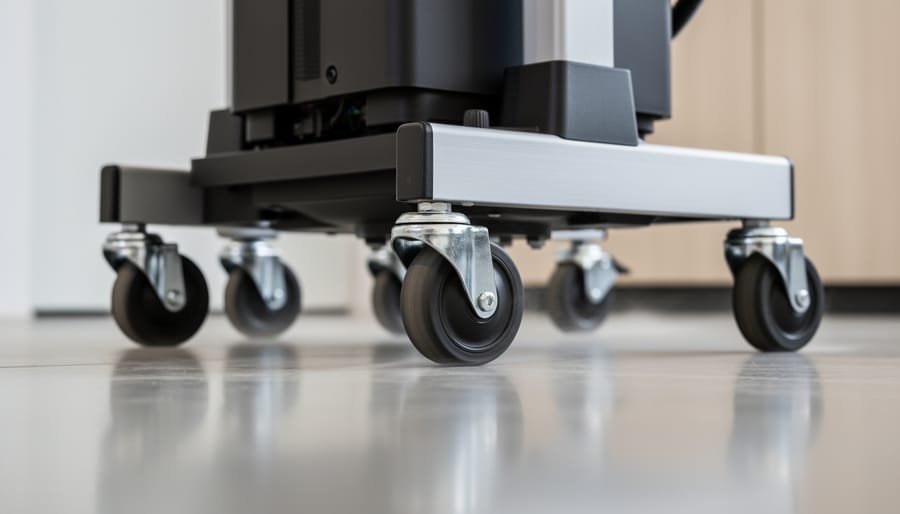
At the end of each leg sits a caster, which is simply the wheel assembly. Each caster has a wheel (or a pair of wheels), a housing, and a caster stem, the short metal post that pushes into a socket in the leg. Many stems are held by friction alone, which is why casters can be pulled out by hand, though some use a retaining ring or clip to stay put. Wheel material matters too: harder wheels suit carpet, while softer ones protect hardwood and tile.
At the center of the base, the gas lift cylinder fits into a tapered hole. A cylinder cover, sometimes called a bell or sleeve, slides over it to hide the metal and keep dust and debris away from the seal.
Finally, the hardware holds it all together: bolts, washers, and retaining clips (often C-clips or E-clips). They are small, but a missing clip or a loose bolt is a common reason a chair feels wobbly.
Use this table to match a name from a parts listing to the chair in front of you. Many parts go by more than one name, so the alternate names column can save you a frustrating search.
| Part | Also Called | What It Does | Zone |
|—|—|—|—|
| Seat pan | Seat plate, seat board | Rigid base that supports the cushion | Seat and back |
| Seat cushion | Foam, padding | Provides comfort and pressure relief | Seat and back |
| Backrest | Back frame, back panel | Supports your spine and shoulders | Seat and back |
| Armrest | Arm assembly (arm post plus arm pad) | Supports forearms and reduces shoulder strain | Seat and back |
| Tilt mechanism | Control plate, synchro mechanism | Lets the seat and backrest recline | Mechanism |
| Gas lift | Pneumatic cylinder, gas cylinder | Raises and lowers the seat height | Mechanism |
| Tension knob | Tilt tension control | Adjusts how firmly the chair resists leaning back | Mechanism |
| Star base | Five-star base, chair base | Spreads weight and keeps the chair stable | Base |
| Caster | Wheel, roller | Lets the chair roll across the floor | Base |
| Cylinder cover | Bell, telescopic cover | Shields the gas lift from dust and wear | Base |
If a listing uses a term you don’t recognize, check the zone first, then scan the alternate names. Worn fabric or foam usually points to the seat and back zone, and a cover repair is often a smaller job than people expect. If you are dealing with damaged upholstery, the seat pan, cushion, and backrest rows are the ones to reference.
Think of the chair as a chain, with every part passing force to the next one down. The moment you sit, your weight lands on the seat pan and cushion, which sits on the mechanism plate underneath. That plate is the tilt mechanism, and it decides how far the backrest can recline as you lean back. The tension knob simply sets how much pushback you feel.
Below the mechanism, the gas lift cylinder does the heavy lifting, literally. It holds your weight steady and controls the seat height. Here is the sequence when you adjust it:
Because each part depends on the one above it, a problem often shows up in a different spot than its cause. A chair that slowly sinks while you work points to the gas lift. A wobble when you roll is usually a worn caster stem or a loose base. Reading the diagram from top to bottom helps you trace the symptom back to its source.
A parts diagram earns its keep the moment something goes wrong. Once you know the names, symptoms point to suspects quickly. A seat that slowly sinks usually means a worn gas lift cylinder. A wobble or rock often traces back to the base, a loose caster stem, or a missing retaining clip. A backrest that won’t hold its angle suggests the tilt mechanism.
The same vocabulary helps when you order replacements. Match the label on the diagram to the part in your hand, then check sizes before you buy, such as caster stem diameter or cylinder dimensions. When you call a repair professional, saying “the gas lift is losing pressure” saves time and gets you a more accurate quote.
Property managers and adjusters will find a diagram useful for documentation, too. Photograph the damage and reference the specific parts, like a cracked seat pan or a bent armrest post, so a claim is clear and complete.
Some fixes are simple, like swapping casters or tightening bolts. Others, such as gas lift removal or frame repair, are best left to a professional. Reupholstering and armrest or frame restoration are common jobs that can bring a well-built chair back to full service.
The flat control assembly bolted under the seat pan is the tilt mechanism, sometimes called the control plate. It holds the adjustment levers and lets the backrest recline.
That’s the gas lift cylinder, also called the pneumatic column. It raises and lowers the seat when you press the height lever, and a sinking seat usually means it has worn out.
Some are, especially casters and gas lifts, which follow common size standards. Mechanisms, armrests, and seat pans are usually brand-specific, so check measurements or the model number before ordering.
Pull a caster out and measure the stem’s diameter and length, since those two numbers matter most. Then match the stem type and the wheel size to your chair, or bring the old caster along when you shop.
One more question comes up often: when is it worth repairing a chair rather than replacing it? If the frame, base, and mechanism are sound, repair is usually the smarter move. Swapping a gas lift or casters costs far less than a new chair, and a quality frame can last for years. Cosmetic wear matters less than structural health, so even cosmetic issues like upholstery holes can often be repaired without replacing the whole chair. Replacement makes more sense when the frame is cracked, the mechanism is failing, or several major parts need work at once.
Knowing what each part is called turns a confusing pile of components into a clear picture. With a diagram in hand, you can pinpoint a sinking seat, a wobbly base, or a worn armrest and describe it in words a repair specialist will understand right away. That saves time, prevents ordering the wrong replacement, and makes every conversation about your chair easier.
Some fixes are quick wins at home. Others, like frame repairs or reupholstering, deserve a trained hand, and it helps to understand upholstery repair costs before you decide. When your chair needs more than a quick fix, reach out. We’re glad to help.